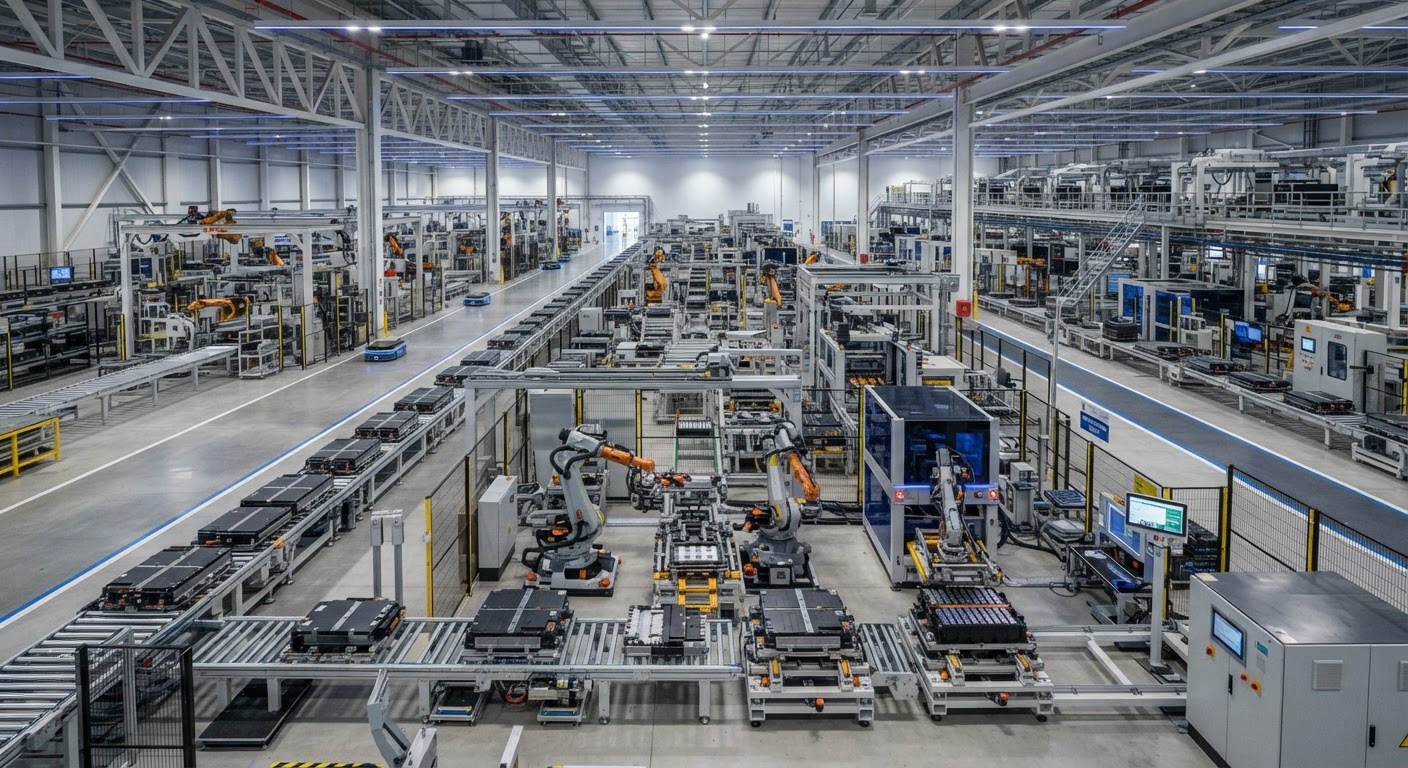
The global energy transition has a geography problem. The components that make it possible — battery cells, solar wafers, power electronics, EV traction motors — are overwhelmingly manufactured in East Asia. The markets that want them fastest — Europe, the Middle East, Africa — are far away. The solution emerging in 2025 is a manufacturing triangle that connects Chinese technology, Egyptian production zones, and Gulf demand and capital.
This isn't a projection. It's already happening at scale. In Egypt's Suez Canal Economic Zone, Chinese companies have committed over $3 billion to new-energy manufacturing facilities in the past 24 months. In Saudi Arabia, Chinese solar manufacturers are building gigawatt-scale production capacity. In the UAE, Chinese EV companies are establishing assembly operations that serve both the domestic Gulf market and re-export to Africa and Southern Europe.
Why Egypt?
Egypt's emergence as a new-energy manufacturing hub isn't accidental. It's the product of deliberate policy, geographic advantage, and a narrowing cost differential with Chinese domestic production.
The SCZone offers what few other locations can: direct Suez Canal access (shortest sea route from Asia to Europe), duty-free export to EU markets under the EU-Egypt Association Agreement, competitive energy costs (Egyptian industrial electricity rates are among the lowest in the MENA region after recent gas discoveries), and a young, trainable workforce with rapidly improving technical education infrastructure.
Most importantly, Egypt has committed to building the entire value chain. It's not just offering factory space. It's developing upstream materials processing (polysilicon for solar, cathode materials for batteries), midstream component manufacturing, and downstream assembly — with the explicit goal of capturing 30-40% of value-add within Egyptian borders. For Chinese manufacturers facing Western tariff pressure and looking to diversify production geography, this integrated approach is compelling.
The Gulf as Demand Anchor
The Gulf states are not just investors in this triangle — they are the demand anchor that makes the manufacturing economics work. Consider the numbers:
- Saudi Arabia has committed to installing 130 GW of renewable energy capacity by 2030. Current installed capacity: approximately 5 GW. The solar panel procurement pipeline alone exceeds $20 billion over the next five years.
- The UAE's EV market is growing at over 30% annually, supported by aggressive charging infrastructure deployment (over 800 public charging stations added in 2024 alone) and government fleet electrification mandates.
- Qatar, Kuwait, and Oman have collectively announced over $50 billion in renewable energy and grid modernization investment through 2030.
These procurement commitments create a demand base that justifies local manufacturing at scale. A solar panel factory in Egypt's SCZone can serve the Saudi and Gulf market duty-free through the Greater Arab Free Trade Area (GAFTA), while simultaneously accessing EU markets under the Egypt-EU agreement. A battery assembly plant can serve Gulf EV production while exporting cells to Eastern Europe. This dual-market access is what makes the economics work.
What's Being Built
The on-the-ground activity falls into several categories:
Solar manufacturing. Chinese solar giants are establishing ingot-to-module production in Egypt, attracted by competitive electricity (solar manufacturing is energy-intensive), trade access, and proximity to the world's fastest-growing solar markets. The production isn't just for local consumption — Egypt is positioning as a solar export hub to Europe, where Chinese-made panels face trade restrictions.
Battery and energy storage. LFP battery cell production is being established in the SCZone, targeting both EV and stationary storage applications. The Gulf's massive grid-scale battery storage requirements — needed to integrate intermittent solar into national grids — create a captive initial market. As production scales, European export becomes viable.
EV assembly and components. Several Chinese EV manufacturers have announced CKD (completely knocked down) assembly operations in Egypt and the UAE. These operations start with assembly and progressively localize component supply — wiring harnesses, seats, glass, and eventually power electronics. Egypt's automotive sector already employs over 80,000 workers; the EV transition is accelerating its upgrade to higher-value manufacturing.
Green hydrogen equipment. Egypt and Saudi Arabia are among the world's most ambitious green hydrogen developers. Electrolyzer manufacturing — currently concentrated in China and Europe — is beginning to localize. Chinese electrolyzer technology, which leads the world on cost per kilowatt, is being transferred to Egyptian production facilities through joint ventures.
The Platform Role
For cross-border industrial platforms, the new-energy triangle presents a distinctly different opportunity from traditional manufacturing relocation. The technologies are evolving rapidly — battery chemistry, solar cell architecture, power electronics topology — which means the manufacturing partner you choose today needs to have a credible R&D pipeline for tomorrow. The regulatory environment is complex and changing: EU carbon border adjustment mechanism (CBAM), rules of origin requirements, local content thresholds. And the capital requirements are large: a competitive solar cell factory is a $200-500 million investment; a battery gigafactory is $1 billion+.
The platform's value is in navigating all three dimensions simultaneously — identifying the right Chinese technology partner, structuring the joint venture to satisfy local content requirements, qualifying the facility for export certification, and arranging the blended financing (Chinese policy bank debt, Gulf sovereign equity, host country incentives) that makes the capital stack work.
The energy transition is the largest industrial reallocation of capital in history. The China-Egypt-GCC triangle is where a significant fraction of that capital is being deployed — not in PowerPoint presentations, but in concrete, steel, and production lines that will shape global energy supply chains for decades.
For manufacturers, investors, and governments watching this space, the strategic question is no longer whether this triangle will form. The production lines are already running. The question is who will capture the integration value — and the platform players who can operate fluently across the Chinese, Egyptian, and Gulf contexts are best positioned to answer it.