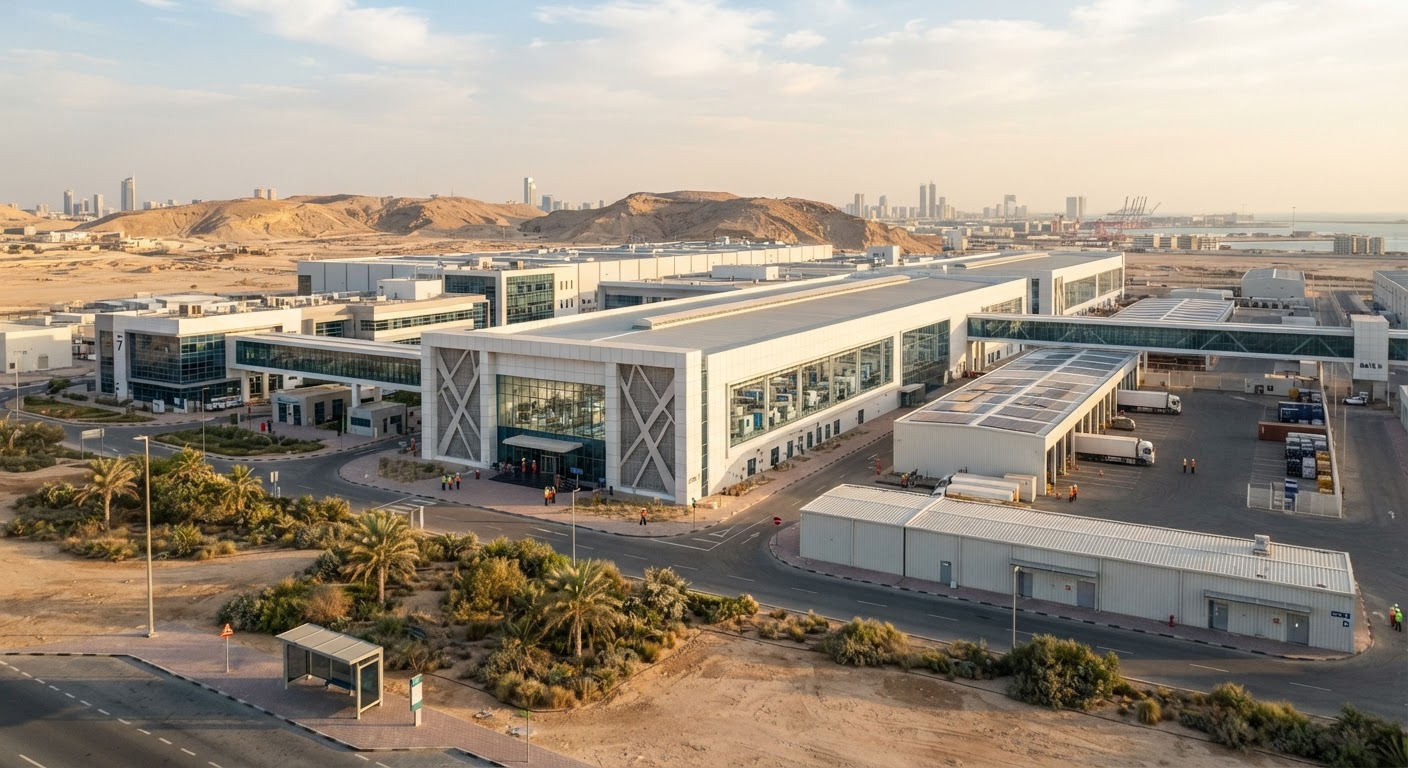
The Gulf states are not building factories. They are building the factory of the future — automated, connected, and data-driven — and they are doing it from scratch. This is an underappreciated advantage. Unlike Germany or Japan, where Industry 4.0 must be retrofitted onto legacy production lines, the UAE and Saudi Arabia are writing on a blank page. And they are writing it increasingly in partnership with Chinese automation companies.
Walk through KEZAD (Khalifa Economic Zones Abu Dhabi) or JAFZA (Jebel Ali Free Zone) today and you'll find something striking: new manufacturing facilities deploying collaborative robots, automated guided vehicles, and AI-powered quality inspection systems at densities that would be notable even in Shenzhen. These aren't experimental labs. They're production lines making automotive parts, electronics assemblies, and construction materials — at volumes that compete with established Asian manufacturers.
The Leapfrog Logic
The economic logic of Gulf automation is different from what drove automation in high-wage economies. In Germany or Japan, automation was a response to labor cost — replacing expensive workers with capital equipment. In the Gulf, where energy costs are low and labor costs are moderate (but skills gaps are real), automation serves a different function: it's about quality consistency, process repeatability, and reducing dependence on expatriate technical labor that is inherently transient.
A robotic assembly cell in Abu Dhabi doesn't ask for a two-year contract renewal. It doesn't take its skills to a competitor in another emirate. It delivers the same weld quality at 2 AM as it does at 2 PM. For Gulf manufacturers competing on quality rather than cost — which is the explicit strategy of Operation 300bn — this consistency is worth the capital expenditure.
Why Chinese Automation Companies Are Winning
Three factors give Chinese industrial automation providers an edge in the Gulf market:
1. Price-performance ratio. A six-axis collaborative robot from a leading Chinese manufacturer now costs 40–60% less than a comparable European or Japanese model, while delivering 85–95% of the performance on key metrics like repeatability and mean time between failures. For a greenfield factory making commercial-grade products (not aerospace or medical), that differential is decisive.
2. Integration flexibility. Chinese automation firms are more willing than their European counterparts to customize control software, adapt communication protocols, and integrate with mixed-vendor environments. This matters enormously in the Gulf, where factories often mix Chinese mechanical equipment with European sensors and American enterprise software.
3. Financing and after-sales. Chinese equipment exporters increasingly bundle competitive financing — often through Chinese policy banks or the suppliers' own balance sheets — with on-the-ground service teams. For Gulf manufacturers who have been burned by sophisticated European equipment sitting idle because the nearest service engineer is in Stuttgart, the presence of a permanent Chinese service team in JAFZA is a genuine differentiator.
Real Deployments
The trend is visible in specific installations. In KEZAD's metals cluster, a Chinese-owned aluminum extrusion plant uses machine vision systems from a Hangzhou-based AI company to inspect surface finish at line speed — replacing the manual inspection stations that were standard in the facility's previous layout. Defect detection rates improved from 92% to over 99%, and the inspection data feeds back into the extrusion control system in a closed loop that adjusts parameters in real time.
In Dubai Industrial City, a contract electronics manufacturer serving the regional automotive market has deployed Chinese SMT lines with integrated automated optical inspection (AOI) running on deep-learning algorithms trained on millions of PCB images. The system catches solder defects that escape traditional rule-based AOI — and it gets better every month as the model ingests more production data from the line.
In Saudi Arabia's MODON industrial cities, the first wave of Chinese-invested factories is being built with automation densities that exceed the investors' own facilities in China. The reason is pragmatic: finding and retaining skilled production workers in Saudi Arabia's emerging manufacturing sector is harder than in Guangdong, so the business case for automation is stronger from day one.
The Platform Layer
For cross-border industrial platforms like MRYK Group, the Gulf's automation push creates a specific opportunity: the integration layer. Chinese automation hardware is increasingly competitive. What the Gulf market needs is the layer that connects the hardware to the local context — the control system integration, the operator training in Arabic, the preventive maintenance schedule adapted to Gulf operating temperatures, the compliance documentation for local electrical and safety codes.
This is not a technology problem. It's a translation problem — translating between the engineering culture of Shenzhen and the operational reality of Abu Dhabi. The companies that solve this translation layer will capture disproportionate value in the China-Gulf industrial technology corridor.
The Gulf isn't buying robots. It's buying manufacturing sovereignty — the ability to produce at global quality standards without depending entirely on expatriate labor markets that are, by design, temporary. Chinese automation is the most cost-effective path to that sovereignty.
As Saudi Arabia's Vision 2030 enters its second decade and the UAE's industrial strategy accelerates, the question for manufacturers isn't whether to automate — it's which automation partner to choose. The answer, increasingly, comes from the east.